Introduction
Modern applications depend heavily on APIs to communicate, share data, and power user experiences. As organizations build increasingly interconnected systems, the attack surface grows with every new endpoint exposed. API security testing has become a foundational discipline in application security, enabling teams to identify vulnerabilities before malicious actors can exploit them. Without a structured testing strategy, even well-designed APIs can contain critical flaws that expose sensitive data, compromise user accounts, or disrupt core business operations. This guide explores everything you need to know to build a robust approach to securing your APIs.
What Is API Security Testing and Why It Matters
API security testing is the process of evaluating application programming interfaces for vulnerabilities, misconfigurations, and logic flaws that could be exploited by attackers. Unlike traditional web application testing, API testing focuses on backend communication channels rather than visual interfaces.
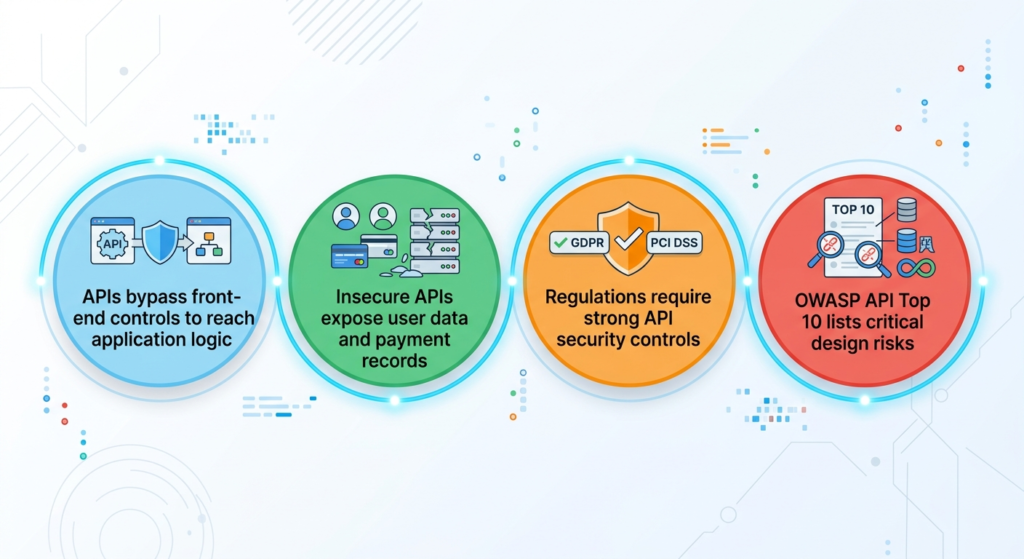
- APIs often bypass frontend controls, making them a direct route to core application logic
- Breaches through insecure APIs can expose user data, payment records, and internal system information
- Regulatory frameworks such as GDPR and PCI DSS increasingly require demonstrable API security controls
- The OWASP API Security Top 10 lists broken object-level authorization, excessive data exposure, and lack of resource limiting among the most critical risks
Understanding the OWASP API Security Top 10
The OWASP API Security Top 10 is the industry-standard reference for categorizing API vulnerabilities. Published by the Open Web Application Security Project, it guides security teams in prioritizing their testing efforts.
- Broken Object Level Authorization (BOLA) allows attackers to access resources belonging to other users
- Broken Authentication enables unauthorized actors to impersonate legitimate users or systems
- Broken Function Level Authorization exposes administrative endpoints to standard users
- Unrestricted Resource Consumption, formerly known as lack of rate limiting, allows denial-of-service attacks
- Security Misconfiguration covers improper HTTP headers, verbose error messages, and open CORS policies
Key Types of API Security Testing Techniques
A comprehensive api security testing program uses multiple techniques to cover different vulnerability classes. Each method uncovers distinct categories of risk that others may miss.
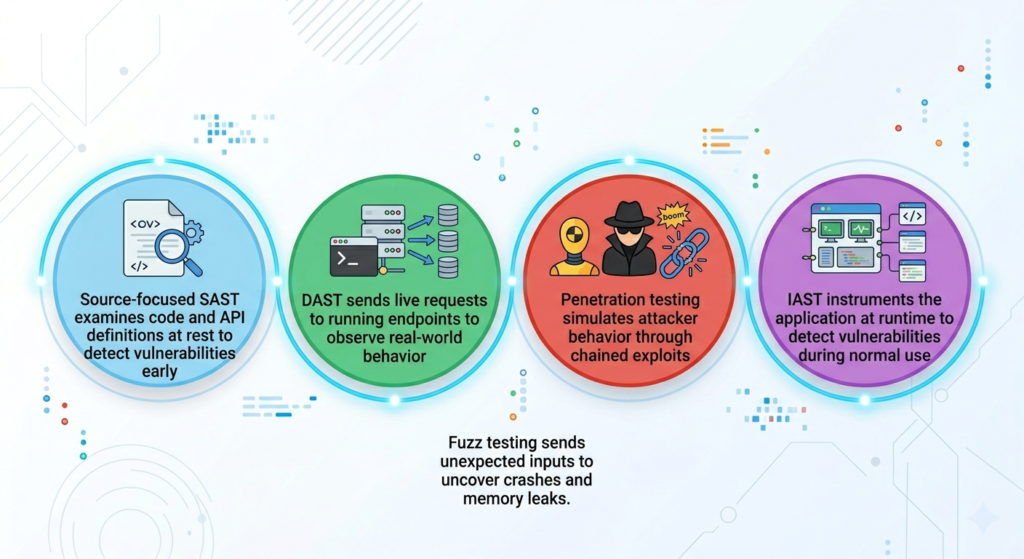
- Source-focused SAST examines the underlying source code and API definitions at rest, detecting vulnerabilities before the application ever runs.
- Dynamic Application Security Testing (DAST) sends live requests to running endpoints to observe real behavior
- Fuzz testing sends malformed or unexpected inputs to uncover crashes, memory leaks, and injection points
- Penetration testing simulates real-world attacker behavior through manual exploration and chained exploits
- Interactive Application Security Testing (IAST) instruments the application at runtime to detect vulnerabilities during normal use
Common Vulnerabilities Discovered During API Security Testing
Security engineers regularly uncover a consistent set of vulnerabilities when testing REST APIs, GraphQL endpoints, and microservice architectures. Understanding these weaknesses helps prioritize testing coverage.
- Injection flaws including SQL injection, command injection, and NoSQL injection remain prevalent in API parameters
- Insecure Direct Object References (IDOR) allow authenticated users to access other users’ data by modifying identifiers
- Sensitive data exposure occurs when API responses return excessive fields such as passwords, tokens, or internal IDs
- Mass assignment vulnerabilities allow attackers to bind unexpected request properties to server-side objects
- JWT (JSON Web Token) weaknesses including algorithm confusion and weak signing secrets enable token forgery
Essential Tools Used in API Security Testing
The right toolset accelerates discovery and enables repeatable, automated testing pipelines. Both commercial and open-source options are available to security teams of all sizes.
- Burp Suite Professional remains the most widely used tool for intercepting, modifying, and replaying API requests
- OWASP ZAP provides an open-source alternative with automated scanning and scripting capabilities
- Postman supports manual functional testing with the ability to add security-oriented test scripts
- Nuclei enables template-based automated scanning across large API surfaces
- Swagger UI and OpenAPI specifications serve as blueprints that help testers map all available endpoints
- Kiterunner specializes in discovering undocumented API routes through wordlist-based brute forcing
How to Test OAuth and Authentication Mechanisms
OAuth 2.0 and OpenID Connect are the dominant authorization frameworks in modern APIs, and they introduce specific attack vectors that require dedicated testing. Weak authentication implementation is one of the top causes of API breaches.
- Test for authorization code interception by checking redirect URI validation and state parameter enforcement
- Verify that access tokens have appropriate expiration times and are invalidated upon logout
- Check for token leakage in logs, URL parameters, Referer headers, and error messages
- Attempt scope escalation by requesting broader permissions than the application should grant
- Confirm that refresh token rotation is enforced and that old tokens are rejected after use
Best Practices for Building a Secure API Testing Strategy
Establishing a repeatable and scalable api security testing process requires aligning people, tools, and processes across development and security teams. Ad hoc testing leaves gaps that systematic approaches eliminate.
- Shift testing left by integrating automated security scans into CI/CD pipelines using tools such as OWASP ZAP or Nuclei
- Maintain an up-to-date inventory of all API endpoints, including internal, partner-facing, and deprecated routes
- Use threat modeling to prioritize endpoints that handle authentication, payments, or sensitive personal data
- Define security requirements for every API before development begins rather than retrofitting controls later
- Conduct regular manual penetration testing in addition to automated scanning to catch logic-level flaws
API Security Testing in Microservices and Cloud Environments
Microservice architectures and cloud-native deployments introduce additional complexity for security testing. Service-to-service communication, container networking, and dynamic scaling all create new exposure points.
- Test service mesh configurations to ensure mutual TLS (mTLS) is enforced between internal services
- Assess API gateways for misconfigured rate limits, missing authentication enforcement, and overly permissive routing rules
- Review serverless function endpoints for injection vulnerabilities and insecure event source mappings
- Evaluate cloud storage integrations to confirm that APIs do not expose unintended access to S3 buckets or blob containers
- Monitor for shadow APIs, which are undocumented endpoints that exist outside official governance processes
How to Handle API Security Testing in CI/CD Pipelines
Integrating security into the software delivery pipeline transforms testing from a periodic audit into a continuous practice. Automated gates prevent vulnerable code from reaching production environments.
- Add OpenAPI specification linting as a pre-commit step to catch structural security issues early
- Configure DAST scans to run automatically against staging environments on every pull request merge
- Set threshold policies that fail the pipeline if critical or high-severity vulnerabilities are detected
- Use secrets scanning tools to detect accidentally committed API keys, credentials, or tokens in source repositories
- Generate and archive security test reports for each build to support audit trails and compliance requirements
Interpreting API Security Test Results and Prioritizing Remediation
Finding vulnerabilities is only half the work. Security teams must communicate findings effectively and guide developers toward timely, accurate fixes.
- Classify findings using a risk scoring framework such as CVSS to communicate severity consistently
- Provide developers with reproduction steps, root cause analysis, and recommended remediation for each vulnerability
- Distinguish between informational findings, false positives, and confirmed exploitable vulnerabilities
- Retest each remediated vulnerability to confirm the fix is complete and did not introduce new issues
- Track mean time to remediation as a key performance indicator for the security program’s effectiveness
Conclusion
Securing APIs requires more than a single scan or a one-time review. Effective api security testing combines automated tooling, manual expertise, and continuous integration to keep pace with the evolving threat landscape. By adopting the OWASP API Security Top 10 as a foundation, selecting the right tools, embedding testing into development workflows, and prioritizing remediation based on real risk, organizations can significantly reduce their exposure to API-driven attacks. As APIs continue to expand in number and importance, a disciplined and proactive security testing practice is no longer optional. It is a core requirement of responsible software development.
Frequently Asked Questions
What is API security testing?
API security testing is the process of identifying vulnerabilities, misconfigurations, and logic flaws in application programming interfaces to prevent unauthorized access, data exposure, and abuse by attackers.
What is the OWASP API Security Top 10?
The OWASP API Security Top 10 is a list published by the Open Web Application Security Project that identifies the ten most critical API security risks, including broken authorization, injection flaws, and security misconfiguration.
What tools are commonly used for API security testing?
Widely used tools include Burp Suite, OWASP ZAP, Postman, Nuclei, and Kiterunner. These tools support a range of activities from manual interception to automated vulnerability scanning.
How often should organizations perform API security testing?
Organizations should perform automated security scans on every code change and conduct manual penetration testing at least once per quarter or whenever significant changes are made to API architecture or authentication logic.
What is the difference between DAST and SAST in API security?
SAST analyzes source code and API specifications without running the application, while DAST sends live requests to running endpoints to discover vulnerabilities in actual runtime behavior. Both approaches complement each other in a complete security program.
What is BOLA and why is it dangerous?
Broken Object Level Authorization (BOLA) is a vulnerability where an API fails to verify that a user is authorized to access a specific resource. It is one of the most common and dangerous API flaws because it can expose any user’s data to any authenticated user.
Can API security testing be automated?
Yes, many aspects of api security testing can be automated through CI/CD pipeline integration, using tools like OWASP ZAP, Nuclei, and custom scripts. However, manual testing remains essential for discovering complex logic vulnerabilities that automated tools cannot reliably detect.