The blockchain revolution has changed how people think about money, ownership, and digital trust. From decentralized applications to NFTs and DeFi platforms, the Web3 ecosystem is growing fast. That growth has triggered a surge in cyberattacks targeting blockchain systems globally. Web3 security is no longer optional. It is the core requirement of every decentralized application in 2025.nft
What Is Web3 Security and Why Does It Matter
Web3 security refers to the practices, protocols, and tools that protect decentralized applications, blockchain networks, and digital assets from malicious actors. Unlike traditional cybersecurity, it operates in systems where no central authority governs the data, making proactive defense far more critical than recovery.
- Decentralized networks have no central server to patch or monitor quickly.
- On-chain data integrity is permanent, making prevention more valuable than correction.
- A single smart contract flaw can cause irreversible financial losses.
- Users must manage their own security with no institution to assist them.
The Growing Threat Landscape in Blockchain Applications
Blockchain applications face threats that traditional security tools were never designed to handle. Hackers target smart contract code, cross-chain bridges, and user-facing interfaces because they are high-value and often under-protected. Billions of dollars have been stolen from platforms lacking adequate Web3 security measures in recent years.
- Phishing sites mimic real dApp interfaces to steal wallet credentials.
- Bridge exploits drain funds as assets move between networks.
- Flash loan attacks manipulate DeFi protocols within a single transaction.
- Insider threats can embed backdoors directly into a project’s deployed code.
Smart Contract Vulnerabilities: A Silent Danger
Smart contracts are self-executing programs on blockchains like Ethereum, written in languages such as Solidity. When a contract has a flaw, it can be exploited without warning and the outcome is almost always permanent. Reentrancy attacks, where a function runs repeatedly before the contract updates its state, are among the most destructive examples.
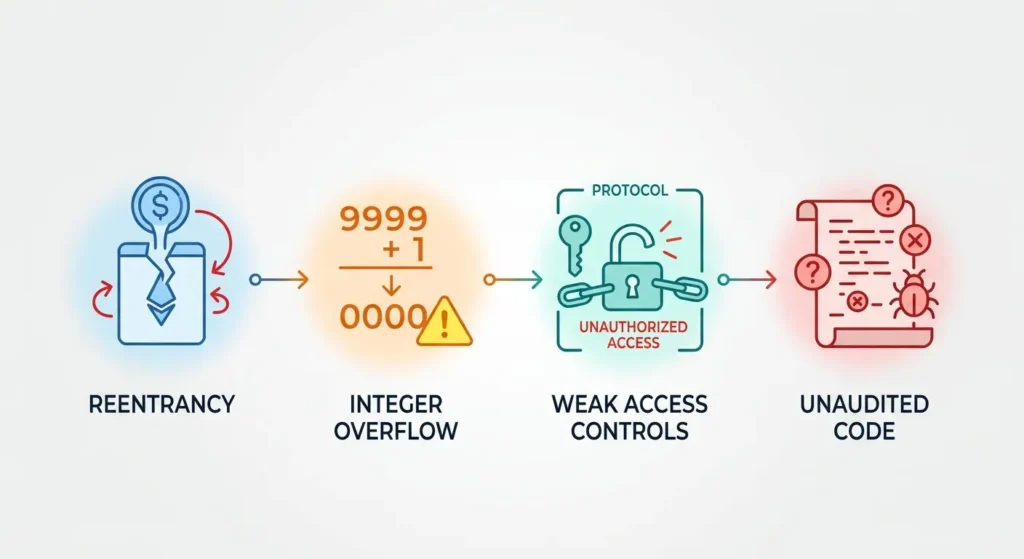
- Reentrancy attacks drained the DAO in 2016, causing losses above 60 million dollars.
- Integer overflow errors let attackers corrupt numerical values in contract logic.
- Weak access controls can grant unauthorized parties full privileges over a protocol.
- Unaudited code remains the leading cause of major blockchain exploits.
DeFi Security Risks and What They Mean for Users
Decentralized Finance, known as DeFi, lets users borrow, lend, and trade without banks. DeFi security risks represent some of the most severe threats in the broader Web3 security landscape today. Because DeFi protocols hold vast amounts of crypto assets, they attract well-resourced and persistent attackers.
- Price oracle manipulation tricks protocols into accepting false asset values.
- Liquidity pool exploits drain funds almost instantly when contract logic fails.
- Protocol composability allows one exploit to cascade across interconnected platforms.
- Users have no legal recourse and usually cannot recover stolen funds.
Crypto Wallet Safety: Protecting Digital Assets
A crypto wallet such as MetaMask is the primary way users interact with decentralized applications. Crypto wallet safety is a practical cornerstone of Web3 security, depending equally on software design and user behavior. Even technically secure wallets can be compromised through phishing or poor key management.
- Private keys must never be shared, as they give total control of a wallet.
- Hardware wallets keep cryptographic keys offline for stronger protection.
- Seed phrases should be stored physically in a secure location, never digitally.
- Always verify the website address before connecting a wallet to any dApp.
The Role of Cryptographic Protocols in Blockchain Defense
Cryptographic protocols are the mathematical systems that underpin Web3 security at every level. They verify transaction authenticity, protect private data, and confirm identities without exposing sensitive information. Every blockchain interaction depends on these protocols working correctly.
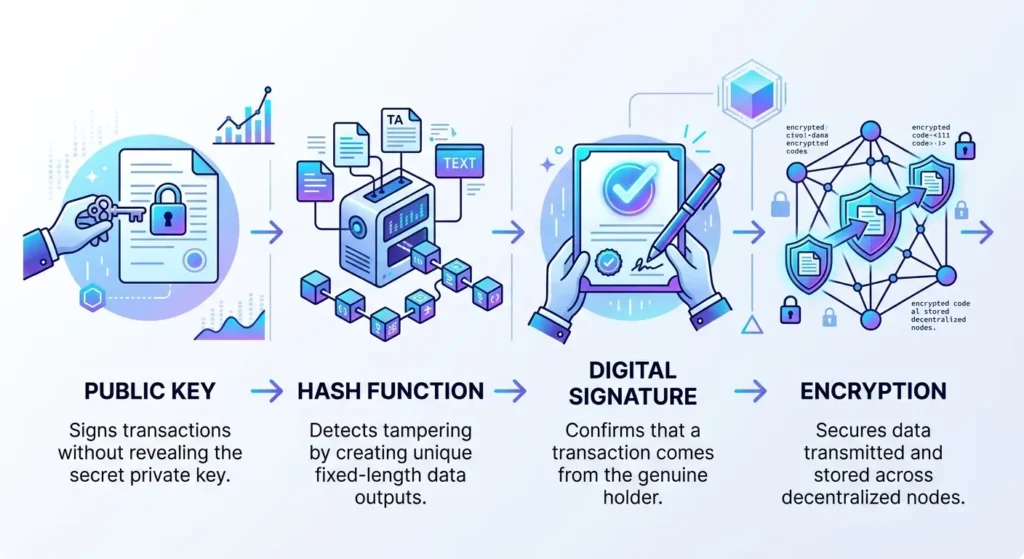
- Public key cryptography lets users sign transactions without revealing their private key.
- Hash functions detect tampering by converting data into fixed-length, unique outputs.
- Digital signatures confirm that a transaction came from the genuine account holder.
- Encryption secures data transmitted and stored across decentralized nodes.
Consensus Mechanisms and On-Chain Data Integrity
Consensus mechanisms define how blockchain nodes agree on the current state of the ledger. They are essential to on-chain data integrity because they prevent any single actor from altering verified records. Proof of Work and Proof of Stake are the two most widely deployed models today.
- Proof of Work makes attacks costly by requiring intensive computational effort.
- Proof of Stake uses economic collateral to discourage dishonest validator behavior.
- A 51 percent attack occurs when one party controls the majority of network power.
- Strong consensus design prevents double-spending and unauthorized record changes.
Zero-Knowledge Proofs: Privacy Without Compromise
Zero-knowledge proofs allow one party to verify a statement as true without revealing the underlying information. This technology improves privacy and scalability in blockchain applications and represents a major advance in modern cryptographic protocols.
- Zero-knowledge proofs enable private transactions on transparent public blockchains.
- They power Ethereum scaling tools such as zk-Rollups, reducing network congestion.
- Verifiable credentials built on this technology let users confirm identity without exposing data.
- They balance user confidentiality with the transparency decentralized systems require.
Real-World Attacks That Shaped Blockchain Development
Major blockchain exploits have produced hard lessons that continue reshaping development standards. Each incident reveals how small technical gaps become catastrophic vulnerabilities, pushing developers and auditors toward stricter practices.
- The DAO hack in 2016 exposed reentrancy risks and triggered an Ethereum hard fork.
- The Ronin Network breach in 2022 resulted in over 600 million dollars stolen from validators.
- The Wormhole exploit in 2022 drained 320 million dollars through a signature verification flaw.
- These events confirm that thorough auditing and active monitoring are non-negotiable.
How to Build a More Secure Decentralized Application
Building a secure dApp demands a security-first mindset at every stage of development. Maintaining Web3 security throughout the product lifecycle distinguishes sustainable protocols from failed ones. Developers, auditors, and project teams all share this responsibility.
- Commission third-party audits before deploying any smart contract to a live network.
- Use established code libraries rather than writing new cryptographic functions from scratch.
- Launch bug bounty programs so ethical hackers can report vulnerabilities responsibly.
- Monitor on-chain activity after deployment to detect suspicious transaction patterns early.
Conclusion
Web3 security is not a feature to add after launch. It must be built into every layer of a blockchain application from the first line of code. As decentralized systems grow more complex and hold greater value, the cost of weak security rises equally. Students and developers entering this space in 2025 must treat security as a core skill. The future of blockchain depends on building systems that people trust completely.
FAQ
What is Web3 security?
Web3 security refers to the tools, practices, and protocols that protect decentralized applications, blockchain networks, smart contracts, and digital assets from cyberattacks and unauthorized access.
Why are smart contracts difficult to secure?
Smart contracts are immutable once deployed, so flaws cannot be corrected after launch. Vulnerabilities such as reentrancy attacks or broken access controls cause permanent losses with no reversal.
How can users protect their crypto wallets?
Using a hardware wallet, storing the seed phrase offline, and verifying website addresses before connecting are the strongest practices for crypto wallet safety.
What makes consensus mechanisms important for security?
Consensus mechanisms protect on-chain data integrity by requiring network-wide agreement on verified transactions, making unauthorized changes computationally and economically unfeasible.