Insider threats in cyber security represent one of the most challenging risks organizations face today. These threats arise from individuals within an organization employees, contractors, or partners who have legitimate access to systems and data but misuse it intentionally or unintentionally. Unlike external attacks from hackers or APT groups, insider threats exploit trusted positions, making them harder to detect and mitigate. Recent reports highlight their growing relevance; for instance, data from cybersecurity firms shows that insider incidents account for nearly 20% of breaches, often leading to massive financial losses and reputational damage. The Verizon DBIR underscores how privileged access amplifies these dangers, turning routine operations into potential catastrophe.
This post dives deep into insider threats in cyber security, exploring their types, real-world impacts, detection methods, prevention strategies, and cutting-edge solutions. By understanding these elements, IT managers and CISOs can build robust defenses aligned with frameworks like NIST and zero-trust models. We’ll cover risks that expose sensitive data, practical prevention tactics including employee training, and tools like UEBA and DLP systems for proactive threat detection. Mastering these approaches ensures GDPR compliance and strengthens overall incident response, safeguarding your organization against internal cyber risks.
What Are Insider Threats in Cyber Security?
Insider threats in cyber security occur when authorized users abuse their access, either through malice, negligence, or coercion. They differ from external threats by leveraging internal knowledge of networks and processes. Organizations must recognize these as a core vulnerability in modern digital landscapes.
Common characteristics include:
- Access to confidential data without raising alarms.
- Exploitation of weak internal controls.
- Potential ties to external actors like nation-states.
Types of Insider Threats
Insider threats fall into distinct categories based on intent and behavior. Malicious insiders act deliberately for personal gain, while unintentional ones stem from errors. Compromised accounts, where credentials fall into wrong hands, bridge both worlds.
Key types include:
- Malicious insiders seeking financial profit or revenge.
- Negligent employees bypassing security protocols.
- Compromised users via phishing or stolen credentials.
Risks Pos posed by Insider Threats in Cyber Security
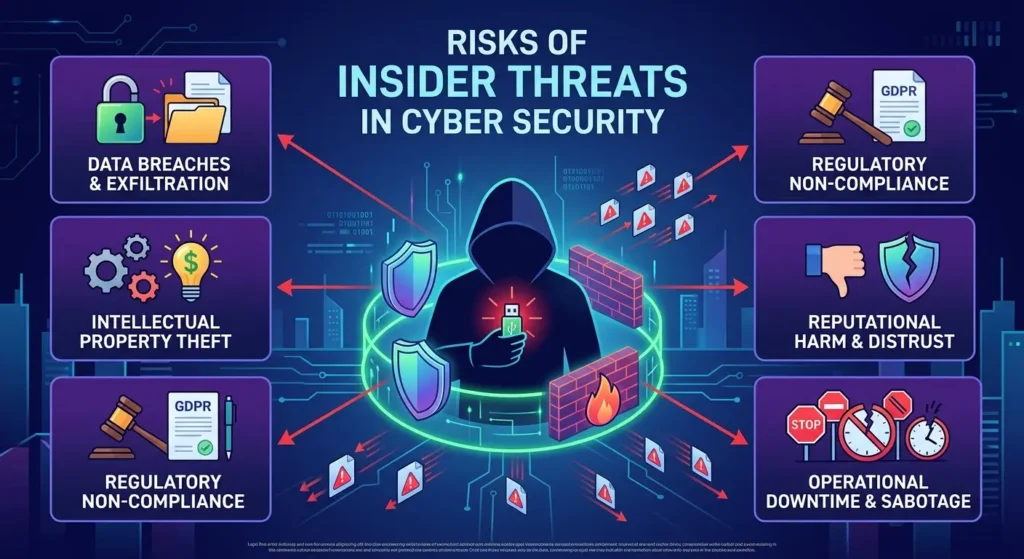
Insider threats in cyber security pose severe risks, from data exfiltration to operational disruption. These internal actors can bypass perimeter defenses, accessing crown-jewel assets like customer databases or intellectual property. The financial toll averages millions per incident, compounded by regulatory fines under GDPR.
Specific risks include:
- Data breaches exposing sensitive information to competitors or the dark web.
- Intellectual property theft fueling rival innovations or state-sponsored espionage.
- Regulatory non-compliance leading to hefty penalties and legal battles.
- Reputational harm eroding customer trust and market share.
- Operational downtime from sabotage, halting business continuity.
- Escalation to advanced persistent threats when insiders collude externally.
Real-World Examples of Insider Impact
High-profile cases illustrate the devastation of insider threats in cyber security. A former employee at a major tech firm leaked source code, crippling product launches. In finance, traders exploited privileged access for insider trading, triggering SEC investigations.
Impacts ripple across sectors:
- Healthcare faces HIPAA violations from negligent staff sharing patient records.
- Energy sectors endure sabotage mimicking Stuxnet-style disruptions.
- Retail suffers inventory manipulation via altered systems.
Why Insider Threats Are Hard to Detect
Detection lags because insiders operate within normal parameters. Traditional tools like firewalls miss subtle anomalies in user behavior. SIEM tools help, but without context, alerts drown in noise.
Challenges involve:
- Blending with legitimate activity.
- Limited visibility into privileged sessions.
- Evolving tactics evading signature-based detection.
Detection Methods for Insider Threats
Effective detection relies on behavioral analytics and continuous monitoring. UEBA platforms profile user activities, flagging deviations from baselines. Integrating SIEM tools with NIST framework guidelines enhances threat hunting.
Proven methods:
- Anomaly detection via machine learning algorithms.
- Log analysis for unusual data access patterns.
- Network traffic inspection for exfiltration attempts.
Prevention Strategies Against Insider Threats in Cyber Security
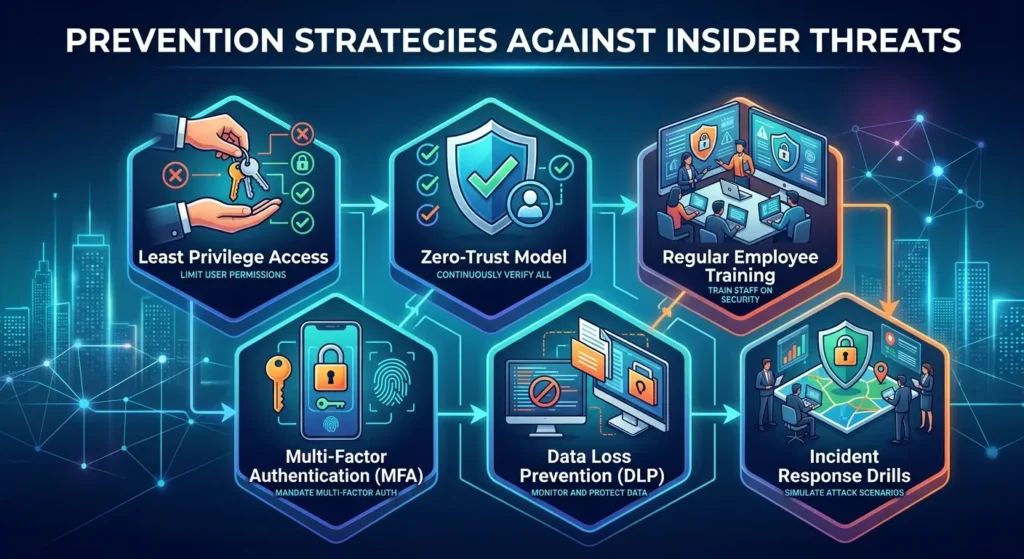
Preventing insider threats in cyber security demands layered defenses starting with policy and culture. Implement least privilege principles to limit access, reducing blast radius. Regular audits and employee training curb negligence.
Core prevention strategies include:
- Role-based access controls enforcing zero-trust model.
- Mandatory multi-factor authentication across all systems.
- Comprehensive employee training on phishing and data handling.
- Data loss prevention (DLP) systems monitoring outflows.
- Background checks and behavioral contracts for high-risk roles.
- Incident response drills simulating insider scenarios.
Building a Zero-Trust Architecture
Zero-trust model assumes no user or device is inherently trustworthy. It verifies every access request, mitigating insider threats in cyber security. Adopt micro-segmentation to isolate critical assets.
Benefits encompass:
- Continuous authentication halts lateral movement.
- Just-in-time access for temporary privileges.
- Automated policy enforcement via identity platforms.
Employee Training and Awareness Programs
Training transforms employees from liabilities to assets. Interactive sessions cover recognizing social engineering and reporting suspicious activity. Measure effectiveness through phishing simulations.
Essential components:
- Quarterly workshops on insider threat indicators.
- Gamified learning for retention.
- Clear reporting channels without retaliation fears.
Role of Technology in Mitigation
Advanced tools like UEBA and DLP provide real-time insights. SIEM integration correlates events for faster threat detection. AI-driven solutions predict risks before escalation.
Deployment tips: Start with pilot programs, scale based on ROI, and integrate with existing stacks.
Advanced Solutions and Tools for Insider Protection
Solutions evolve rapidly, offering automated responses to insider threats in cyber security. UEBA excels at profiling entities, while DLP blocks unauthorized transfers. Here’s where to paste here your custom scripts for enhanced monitoring in SIEM dashboards.
Leading solutions include:
- UEBA platforms like Exabeam for behavior baselining.
- DLP systems from Symantec preventing data leaks.
- Next-gen SIEM from Splunk with insider-focused rules.
- Identity access management (IAM) tools like Okta.
- Endpoint detection and response (EDR) for session forensics.
Incident Response for Insider Events
Rapid response minimizes damage. Develop playbooks tailored to insider scenarios, involving HR for termination protocols. Forensic analysis preserves evidence for legal action.
Steps ensure:
- Isolation of affected accounts.
- Chain-of-custody for logs.
- Post-incident reviews per NIST guidelines.
Compliance and Regulatory Considerations
GDPR and NIST frameworks mandate insider threat programs. Non-compliance invites audits and fines. Map controls to standards for defensible postures.
Key alignments:
- GDPR Article 32 on security of processing.
- NIST SP 800-53 for access controls.
- ISO 27001 for risk assessments.
Future Trends in Combating Insider Threats
AI and machine learning will dominate, predicting threats via predictive analytics. Quantum-resistant encryption secures privileged access. Collaborative ecosystems share threat intelligence.
Expect shifts toward:
- Biometric continuous auth.
- Blockchain for audit trails.
- AI ethics in behavior monitoring.
Conclusion
Insider threats in cyber security demand vigilance across risks, prevention, and solutions. Key takeaways include adopting zero-trust, leveraging UEBA and DLP, and fostering a security-aware culture through training. Real-world impacts underscore urgency, while tools like SIEM ensure detection. As threats evolve with AI and remote work, proactive strategies aligned with NIST and GDPR will prevail. Strengthen your defenses today to protect assets and maintain trust. Prioritize cybersecurity in every decision.
FAQ
What are the main types of insider threats in cyber security?
Insider threats in cyber security include malicious, negligent, and compromised categories. Malicious insiders steal data for gain, negligent ones cause accidental breaches like misconfigured shares, and compromised accounts enable external exploitation. Mitigate with UEBA for behavior analytics and zero-trust access. NIST frameworks guide classification, reducing internal cyber risks through monitoring.
How do insider threats differ from external cyber attacks?
Insider threats leverage trusted access, bypassing firewalls unlike external hacks from APT groups. They blend with normal traffic, evading traditional detection. Employee data breaches often stem from privilege abuse, demanding UEBA and DLP over perimeter tools. This internal focus builds topical authority in threat detection.
How significant is staff education in mitigating internal risks?
Employee training builds awareness of phishing and data handling, curbing negligence. Simulations test responses, aligning with NIST guidelines. It fosters reporting cultures, reducing malicious insiders. For IT managers, integrate with DLP for comprehensive prevention of internal cyber risks.
Which tools are best for detecting insider threats in cyber security?
SIEM and UEBA tools lead detection by analyzing user behavior anomalies. Splunk correlates logs, while Exabeam baselines entities. Pair with DLP for exfiltration blocks. These ensure GDPR compliance amid rising employee data breaches.
How can organizations implement zero-trust to counter insiders?
Zero-trust verifies every access, limiting privileged exposure. Use IAM for just-in-time privileges and micro-segmentation. This model thwarts lateral movement in insider scenarios, per NIST SP 800-53. CISOs benefit from reduced blast radius.
What are common signs of malicious insiders?
Signs include unusual data access, off-hours logins, and bulk downloads. UEBA flags deviations; monitor via SIEM. Early detection prevents breaches, supporting incident response.
How do regulations like GDPR address insider threats?
GDPR mandates security measures against internal risks, including access controls and breach reporting. Align with DLP and training for compliance, avoiding fines from employee data breaches.